The Attic presents The Sonic Turn — International Conference · Nov 14–15, 2025
Sonic Eschatologies: Liminal qualities of compos(t)ing culture/community visions from the other side Photo credits: Stefan & Andreas Fraunberger, Elisabeth Handl

Sonic Eschatologies: Liminal qualities of compos(t)ing culture/community visions from the other side

November 24, 202513-15 minutes read

Written by:

Stefan Fraunberger

Share article:

Introduction

Form is the shadow of sound / the horn of imagination
While navigating the critical zone I heard “after the crash is before the round of blissful spirits”, which might already be: eschatology, the most beautiful community stories.

But what the heck is eschatology? An investigation into space and time? Reflections on mono apocalyptic doom? Are we before, after or in the midst of the lifting of the veil? The qualities of sound and meaning reverberating, disappearing and resonating? The inability to build paradise on earth? Anti-Ideology or Anti-Theology? The second coming? The manifestation of the social construct called culture? The political implications of growing from earth? The driver of alienation? The reason for constant emancipation from concrete? The driver of feedbacks on earth and beyond?

However, as it is obviously impossible to stop questioning the sonic implication of the end, we might take a dive right into the limit, right into the membrane of perception. Anyhow we constantly do that, but with what intention?

Are you feeling dizzy? But wait, what's all of that to do with the horn of imagination? And why is form the material shadow of sound? A constantly composting composition. A material composition reverberating within the horn of imagination, or let's call it sonification.
It cannot yet be said with certainty whether the highest degree of danger lies in the myth of decline, the myth of the final battle of decision, or the myth of the redeemer. Europe’s future remains only moderately secure so long as its citizens, even amid multiple crises, can resist the gravitational pull of mythical solutions—those promised by national-conservative ‘movements,’ imagined ‘brotherhoods,’ and fabricated ‘alternatives. (Sloterdijk 2024)
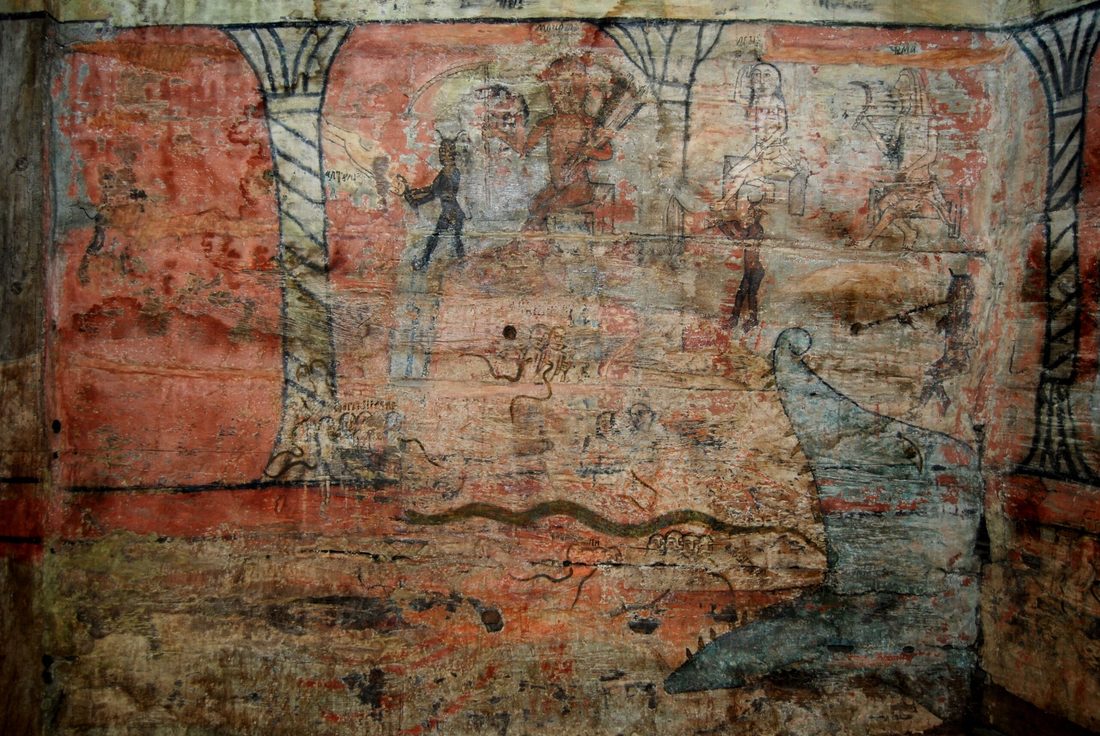
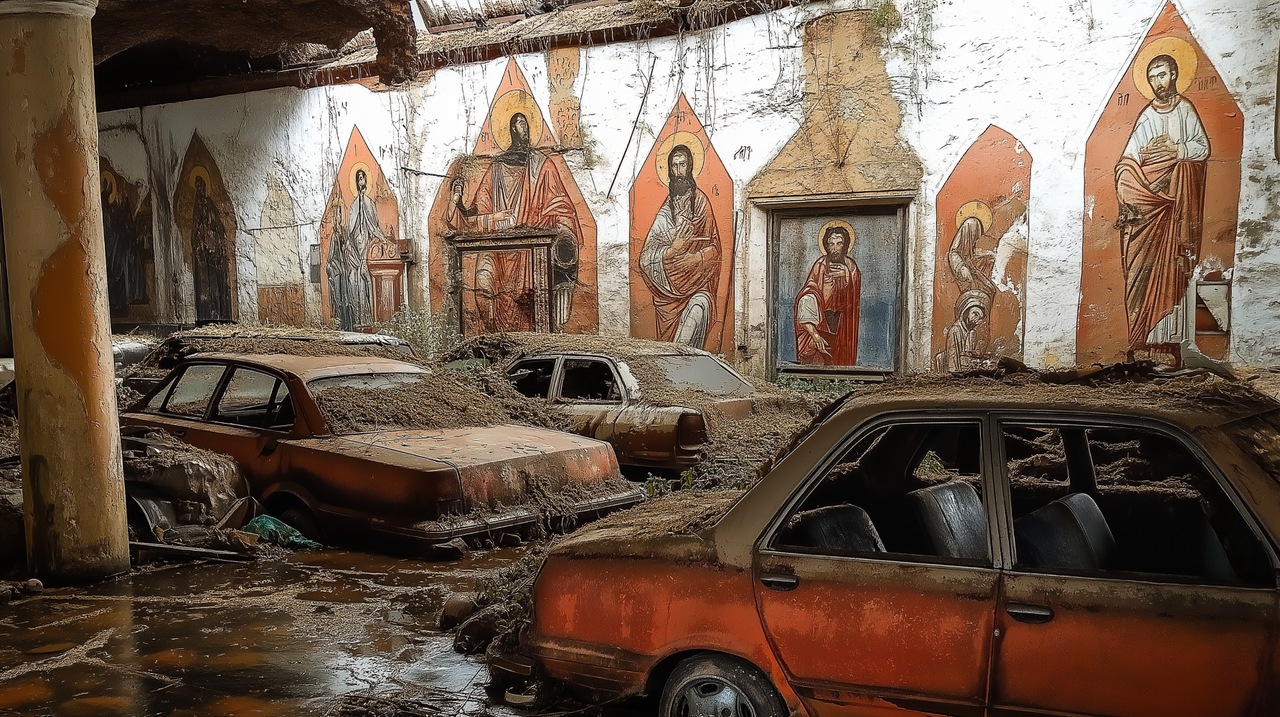
Quellgeister #4 Kuruzenaufstand, Fresco Recycle. Photo Credits: Stefan & Andreas Fraunberger

Sonic Eschatology

A classic example of sonic eschatology as found in the Qur'an: “And the Horn will be blown; and at once from the graves to their Lord they will hasten. They will say, O woe to us! Who has raised us up from our sleeping place?” (36: 51/ 52)

But also in the Bible, we may find: “Now the seven angels who had the seven trumpets prepared to blow them.” (Revelation 8:6 )

Though pre-eschatological, (Exodus 19:16–19) prefigures it—thunder, trumpet blast, and the voice of God shake the mountain, anticipating the apocalyptic soundscapes of Revelation. Here, sound is not just a signal—it’s an agent of transformation: sonic vibration becomes a mode of divine intervention and change. Sonic eschatology in the Qur'an and the Bible is epitomized by the trumpet blasts of Revelation, where sound marks the rupture between the present age and the age to come. The auditory dimension carries theological weight: divine sound reorganizes creation and announces its end.

The question of freedom is the primal theme of apocalyptic thought, and all its motifs point toward the turning point at which the structure of the prison bursts apart. Apocalyptic thought is not at first concerned with changing the social structure of society; rather, it turns its gaze away from the world. If ‘revolution’ means merely replacing an existing social order with a better one, then the connection between apocalypticism and revolution is not evident. But if ‘revolution’ means setting a new totality against the totality of the world, then apocalypticism is, in its essence, revolutionary (Taube 1947).
Wooden Church in Rogoz, Romania. Photo credits: Stefan Fraunberger

Anti End / Beginning

The liminal qualities of composting culture are investigated as an organic revolution. But which revolution? Is there a revolution? A revolution from beyond forming and shaping limits? The opposite of Religion and Ideology trying to install Paradise on Earth? Beyond our ears is sound and sound is remembrance. That might all sound quite mystic, but history of science shows: modern science is a special form of late baroque Christian mystique, where + and -, 0 and 1 replace the basic dialectics of being. Materialism was mistaken with dead materia following on track. The birth of Subject-Object was an abstract form of Master - Slave (Morton 2024), an instrumentalisation of our material preconditions for ruling social constructions with so-called methods (Latour 2021). A method is a form of authority. False authority surpassing being. Imperialism seems to be a method. A reductionistic system trying to enslave being. A method can define an individual entity or a group. Religion and Ideology does so. The gnostic mass movements like Scientivism, Fascism, Communism, Positivism, Colonialism and Postcolonialism are religious methods of projecting evil onto Nonbelievers, of trying to install paradise on earth (Voegelin 1968).

A recent form of politics is the idea of provoking the second coming of prophecy by empowering the end of times, apocalypse with force. Such forms of political and religious agency are recently appearing within anti-cultural forms of Islamic fundamentalism or neo-evangelical American apocalyptic visions. Both think they are the right hand of god themselves. Being absolute truth without tolerating other perspectives seems to be an important pillar of modernist movements as fundamentalism, scientism and political doom. We may name this phenomena geostrategy of imperial and anti-imperial actors (Frankopan 2023) within different cultural frames.

The general introduction to nearly all Mandaean-gnostic writings reads: “In the name of the great, first, alien Life from the exalted worlds of Light, that stands above all works.” In this introduction lies already the guiding thread for understanding the apocalyptic-gnostic sense of life. Within the sphere of apocalyptic thought, the theme of self-alienation resounds for the first time. The alien (or the stranger) is the first great primal word of apocalypticism, and it is entirely new in the history of human speech. The primal word of the alien and the theme of self-alienation run through the whole of apocalyptic-gnostic literature (Taube 1947).

Since ancient times there is a pattern known, for example that heretics being chased by Rome turned to murders in the name of their former heretic religion, that happened within one generation during Christianisation of Rome. Religious Sects, Nation-States, Empires, and Ideologies came to follow on track. Anti-imperial movements going for power became the drivers of the vision of an earthly paradise. The “immanentisation of paradise” becomes an important goal of modernisation and progress (Voegelein 1968). Community pressure is a dangerous entity for society and humanism. Immanentisation navigated by speed and misinformation might also lead to destruction and harm.

Truth seems to be construction, a fashionable filter of trying to avoid the end of times. So why not go straight post apocalypse? Then we are right in paradise (Latour 2017), right where no more responsibility is existing. Me and my rights. Us and our rights. You are wrong, we bring peace by telecommunication. Scroll down the timeline to find paradise on earth. But a very important question within those insights may be, for how long will the paradise on earth last? Is it the main goal to find paradise or to avoid purgatory? Maybe the tension of living between those states, may contain some deep phenomenological answers, which might be heard in the Horn.

So far we might come to the conclusion that the main definitions of Moderns are Anti End / Beginning:
- Nostalgia for Tradition / Keep living in museums enshrining “what's gone”.
- Desire for Tabula Rasa / Destruction, while not being able to Let Go.
“Europe’s most significant—though risky—achievement in the history of civilization consists in having released individuals from the state of total membership in closed cultic and faith communities … Enlightened Europe will remain alive only as long as the creative passions keep those of resentment in check … It cannot yet be said with certainty whether the highest degree of danger lies in the myth of decline, the myth of the final battle of decision, or the myth of the redeemer. Europe’s future remains only moderately secure so long as its citizens, even amid multiple crises, can resist the gravitational pull of mythical solutions—those promised by national-conservative ‘movements,’ imagined ‘brotherhoods,’ and fabricated ‘alternatives.’” (Sloterdijk 2024)

The Revolution Will Not Be Televised

(Gil Scott-Heron)
So what might the notion of Eschatology mean for us in a secular world, where theoretically we are free to believe in endings and beginnings as we want, where we are free to renounce spiritual imperialism. No more endings? Paradise lost? Paradise arrived? (John Milton 1667)

Hold on a second: ending means community – probably community and culture without force? What's that sound again?

Hearing and imagination are not corrupt. Just the interpretation of its meanings is corrupt. So we might think about the possibilities of hearing, the possibilities of culture composting, the possibilities of things ending and transforming. Not the force of wanting to stop the process of transformation by means of imperial or anti-imperial methods. Individuality, Community and change are possible because of things ending and beginning. By holding onto the past we are trying to freeze sound, we are trying to make so called Nature a parking space for empty machines.

Sound fades, like being fades and begins. A process called Transformation. A process called Revolution. Probably that's why it is said that the most beautiful community stories are apocalyptic visions (greek: the lifting of the veil). Probably that's the meaning of Eschatology. A sonic revolution.

Things change in-between. No inbetween without a relation. No relation without change. No community without individuality. No apocalyptic vision without the hope for tomorrow. No responsibility without an end.

Finally there is no recipe for a revolution.

If the revolution of the soul is in resonance with sound we might just skip the apocalyptic visions of the church of the freed slaves. Not going into classic christian eschatology, it is important to be alert about the whispering game of telephone: from one ear to the other, the meaning of “love your neighbour then yourself” might become: “kill the class-enemy.” So far it is hard to say whether the revolution of class and community are fully related to antique apocalyptic thought or we are facing a classic example of spiritual distortion of gnostic thought.

Do you know the feeling of having forgotten why you are in conflict? In the same sense we might question the feeling of being betrayed by earth. We might have forgotten why we want revenge on earth by means of gnostic tanks like cars or weapons of extraction. Our angry selves are in conflict with the earth. So what about going for Reverse Gnosis (Morton 2024). A neuroplastic effort: is our body / earth a prison or is it a temple?

Somewhere between our perception, alienation and emancipation, the self is finding its place to once again start listening. We might come to the conclusion that neuroplasticity and sonic character are related results of the uncanny. Earth being the uncanny place of the language of things taking place. Beyond each imaginary imperialism, beyond each account lies a fear waiting to be unveiled.
"While the mind is rolling in fear, flat earth is becoming a ball".
"Religion was brought to earth by god and organised by the devil."
(William Blake)
Europe, or lets say the current state of modernity seems to be a Composted Empire without characteristics. Accelerated Mobility and Telecommunication are giving us the impression we are stable – virtual versus real could be translated into infinitive being as a pixel on mars versus finite community on earth.

Probably one of the most harsh modern-day colonialists named Cecil Rhodes had a Synthesis of whiteness, anglophonia and technical civilisation in mind: as a paradigma of such, Rhodes wanted to build telephone cables from Capetown to Cairo, as a classic expansion of power. Imperialism and telecommunication were heading for the same goals. (Sloterdijk 2024) Since Renaissance times slowly the end of things got the meaning of the end of the bank account. Whoever has his religion, his bank account filled with light might live forever. The expansion of this live-span on a virtual account mostly was related to an extraction on this world, be it from material or from human sources. The holy market became the dominating religion WITHOUT END. Reforms of this religion were doomed from the very beginning. Should we keep secularising, not reforming virtual promises of salvation?
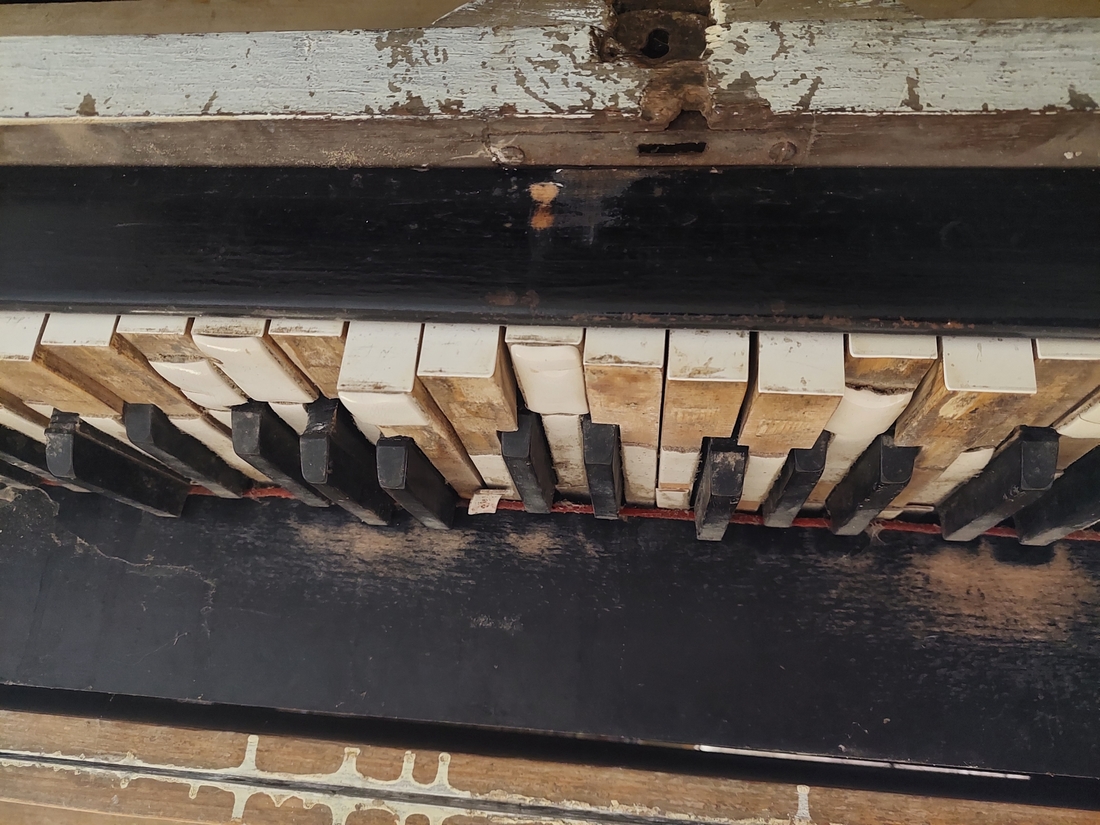
Quellgeister Manual. Photo credits: Stefan Fraunberger

Quellgeister

“Und wenn sich nun die Geister bewegen und wollen reden, so muss sich die harte Qualität auftun, denn der bittere Geist mit seinem Blitze sprenget sie auf, und alsdann gehet heraus der Ton und ist mit allen sieben Geistern schwanger. Die unterscheiden das Wort, wie es im Centro, das ist im mittleren Zirkel, da es noch im Rat der sieben Geister war, beschlossen ward.” (Böhme 1612)

My longterm-project Quellgeister about the character of deserted church-organs is all about sonic eschatology from the perspective of composted and left alone church-organs on their way to the other side - an article about Quellgeister I have written for “the Attic” during Lockdown can be found here.

Meanwhile investigating the character of things, instruments and organs Quellgeister #4 began moving around the following question: What about the possibility of artificial recycling of former cultural imaginations as organs and frescoes? How to find beauty within the principle of disrupted order? How does the development of sonic character relate to an uprising within material transformation?
My obsession about yellowed frescoes depicting witchcraft and imaginations of the other side got a special focus for structural recycling. With a particular interest in those representations that were never renovated, but transformed by climate, bacteria or human intervention, the process of recycling started getting into motion.

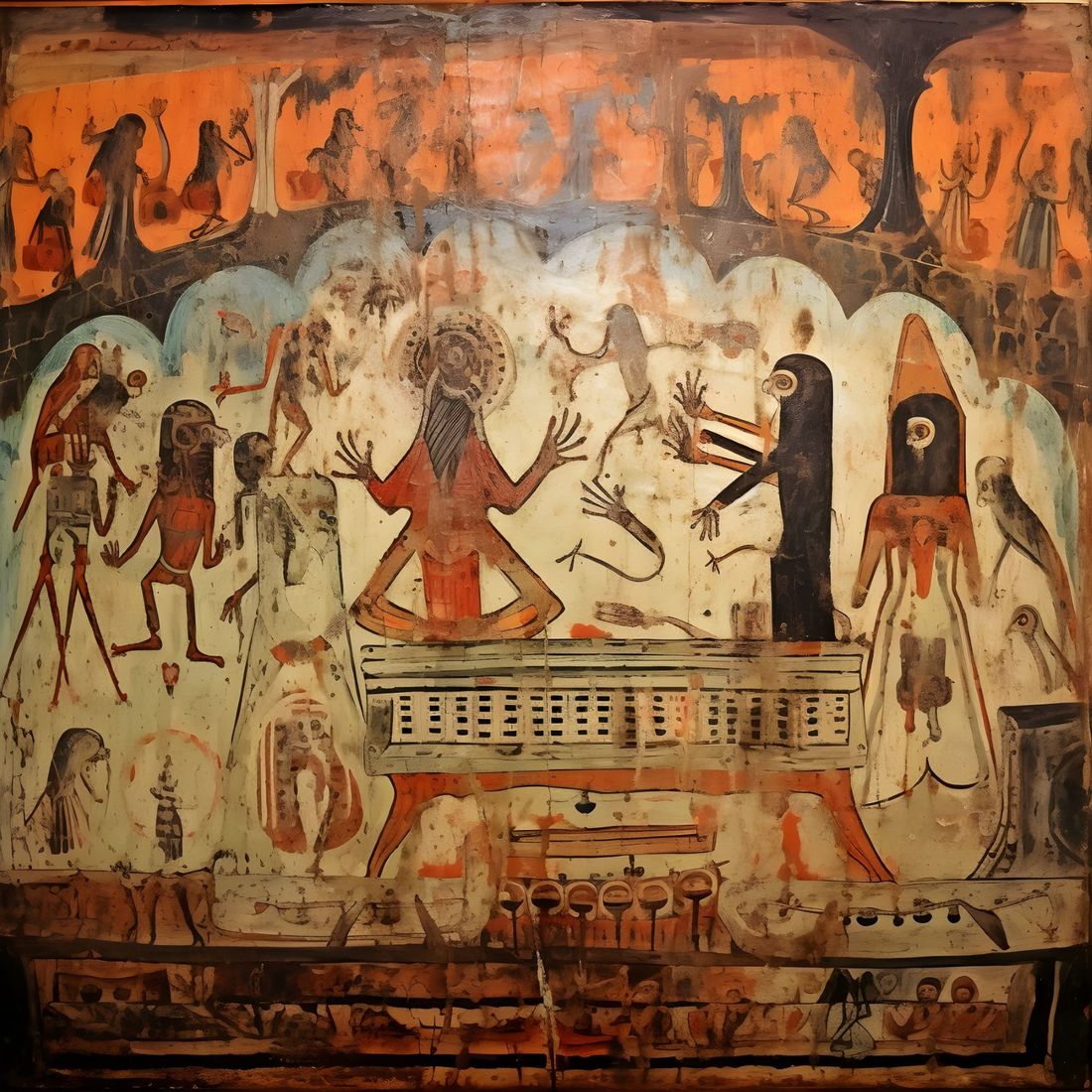
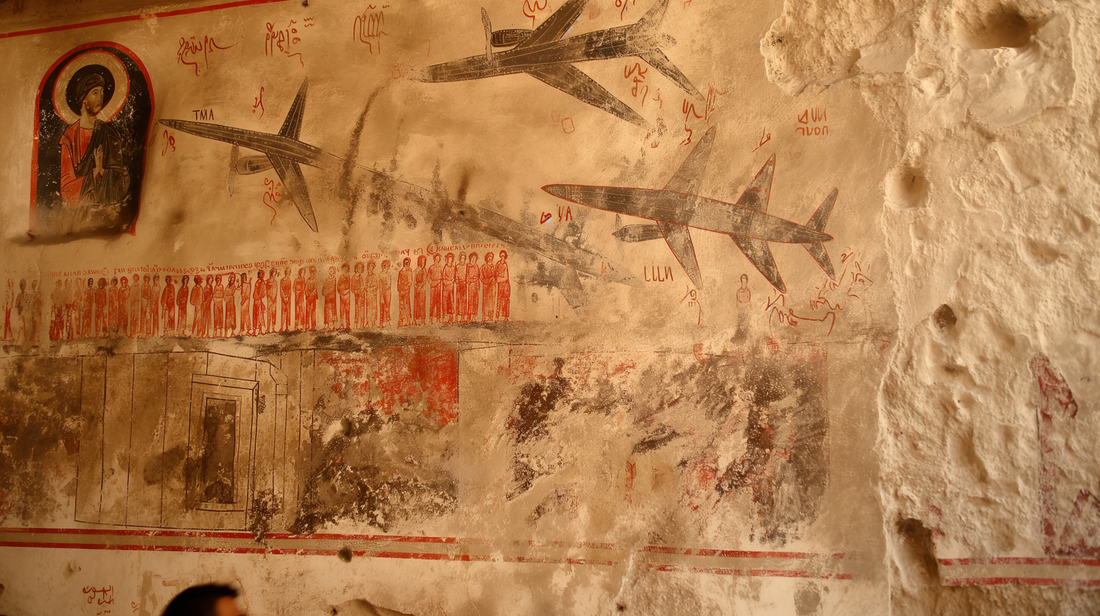
Following the motto ‘Everything that has been composed can also be composted’ (Latour 2021), we examine the touchstone of ecology in the tension between decay and belief in progress. We consider the erosion of naive wooden frescoes and pipe organs through the interpretative filter of artificial intelligence.

Part of our AV investigation is the question of how to deal with organic change within sound and image, given that there is no statistical or quantitative majority to be found. How can we give algorithms, which seek majorities, the opportunity to find a way of dealing with earthly minorities and changes? How do we deal with the increasing blurring of the boundaries between the real and the virtual? What distortions arise when rotten wooden frescoes are moved and overwritten by digital information algorithms?

Based on past fashions of ideas about the afterlife and current, fleeting ideas about technology and progress, we are tracing the crisis of human imagination since the beginning of industrialisation.

Hyperrealism, which has prevailed for almost 500 years, illustrates and defines escapist fantasies, especially in the virtual space of promptings and other digital escapist aesthetics. Our audio-visual research laboratory is located where no time has been saved, where mood, form and character unfold their spirits in organic processes in the intermediate realm of human imagination. The uncanny nature of climate change and AI have one thing in common: human imagination in the spin cycle of the Earth's rotation.
"Culture is a product of imagination, thus the climate-crisis is a crisis of imagination."(Amitav Gosh 2016)
The measured background of the organ and the fresco stage set awaken from their natural backdrop existence and become independent actors. When the theatre of cultural imagination burns, the stage set must be released from its nature. What happens when trained high culture is released into the wild? Can AI understand this?

Eschatology and the Horn of Imagination

Trained AI Recycle Fresco. Photo credits: Stefan & Andreas Fraunberger
As this little investigation into Outviews on Sonic Eschatology is coming to an end, I would like to focus on Shaykh al-Akbar, Ibn Arabi, giving space to his views of sonic eschatology around 800 years before now:

As becomes evident in Ibn ʿArabī’s monumental work al-Futūḥāt al-Makkiyya, an intermediate realm appears to be represented as a horn. Within this formative “instrument” of light, the entire creation is reflected in subtle mixtures of modulated states. Through the symbolic analogy of a physical instrument, corporeality is brought into spatial presence. The Arabic word ṣūr means horn in this context, but it derives from the same root as form—thus producing a wordplay between formative imagination and the apocalyptic trumpet.

It is apparent that the phenomenon of morning disturbances is more significant—and more tragic—than one might generally assume. What kind of involuntary awakening is meant here remains open. Al-Ghazālī seeks greater precision, and in the context of the apocalypse he writes the following in The Precious Pearl on Knowledge of the Hereafter:
“Then God, the Glorified and Exalted, will give life to Isrāfīl—peace be upon him. He will blow the trumpet from the Rock of the Holy House. The trumpet is a horn of light; it has fourteen coils, each one as vast as the circuit of the sun and the earth. Upon it are openings equal in number to the created spirits. Then the spirits of all creatures will emerge from it with a buzzing like that of bees and will fill everything between the two horizons”. (Ghazālī 2003)
Chittick writes that Seraphiel will blow into the barzakhī forms to bring about the resurrection. A ḥadīth states that this is a trumpet of light. “According to Ibn ʿArabī, this refers to the luminosity of the imagination, which stands in relation to corporeal reality.” It is a formal barzakh, a trumpet of light whose highest point is the all-encompassing cloud and whose lowest point is the narrowness of the earth. Within these corporeal forms, the jinn, the angels, and the unmanifest dimension of humanity will appear. (Chittick 1998)
“The form appeared, and thus confusion arose. Is this not the root? Does the form exist in the act of blowing, or does the blowing exist in the existence of the form?” (Ibn Arabi)
Horn of imagination (khayāl) as instrument and faculty. In diverse interpretations, the imaginative faculty (khayāl / al-ʿālam al-mithāl) is creative and real; the “horn” operates within that faculty to sound the forms that will be reified or transmuted at the day of resurrection. This makes eschatology experiential: the “last trumpet” is also an internal, imaginal event that can be described, analysed, and even “heard” in visionary experience.

“For this is a prodigious matter, where even the innermost hearts become bewildered. … Then the prescriber (of Revelation), who is the truthful speaker, called this thing – which is the (divine) Presence of the Barzakh to which we are brought after death and in which we directly witness our souls – a ‘Horn’ (al-sûr) and ‘Trumpet’ (al-nâqûr). Here the word al-sûr is (also) the plural of the word sûra, ‘form’. So (according to the Qur’anic accounts of the Resurrection) “it is breathed into the Horn/forms” (6:73, etc.) and “it is blown upon the Trumpet” (74:8). And the two of them (the “Horn” and “Trumpet”) are exactly the same thing, differing only in the names because of the various states and attributes (of the underlying reality).”

“You should know that God brought the Trumpet into existence in the form of a horn. It was named the ‘Trumpet’ in the way that things are named by the name of what is near to them or causes them. Since this horn is a locus for all the barzakh forms into which the spirits pass after death and in sleep, it was called sûr, the plural of ‘form’. Its shape is that of a horn: its high end is wide and its low end is narrow, like the shape of the cosmos. … The faculties pass with the spirit into that barzakh form in sleep and death. That is why the spirit perceives [in both of these states] by means of all its faculties without distinction.”

In terms of “sonic eschatology”: the trumpet/voice signals the shift from one order to another; the horn is the instrument of transition; the voice/sound (even if not overtly in these quotes) is implicit in the blowing, the “breathing into” the horn/forms (nafakha-ṣūr).

As reality is a social construction and as the End is Society itself (arab: dīn), let's keep resonating astray symmetry within the form of the horn. Lets keep sounding on earth.


    Further Reading:


  1. Blake, William, 2007, Collected Works, Everyman's Library, New York City.
  2. Böhme, Jakob. 1612, Aurora.
  3. Chittick, William C., 1989, The Sufi Path of Knowledge: Ibn al-’Arabī’s Metaphysics of Imagination, Albany: State University of New York Press.
  4. Frankopan, Peter, 2023, The Earth transformed. Bloomsbury
  5. Fraunberger, Stefan, 2012, Das Drama der Zustände, Ibn Arabi’s Barzakh.
  6. Ghazali, Muhammad al-, 2009, Die Kostbare Perle im Wissen des Jenseits. Spohr Publishers Ltd.
  7. Gosh, Amitav, 2016, The great derangement: Climate Change and the Unthinkable. University of Chicago Press. Chicago & London.
  8. Ibn al-ʿarabī. 1240, Al-Futūḥāt al-Makkīyah
  9. Latour, Bruno, 2021, After Lockdown: A Metamorphosis, Polity Press, Cambridge, UK.
  10. Latour, Bruno, 2017, Facing Gaia, Polity Press, Cambridge, UK.
  11. Luckmann / Berger, 1966, Die gesellschaftliche Konstruktion der Wirklichkeit. Anchor Books.
  12. Milton, John, 1667, Paradise Lost.
  13. Morris, James W, 1995, Divine Imagination and the Intermediate World: Ibn ʿArabī on the Barzakh, in POSTDATA (Madrid), vol. 15, no. 2 (1995), pp. 42-49 and 104-109 (Spanish).
  14. Morton, Timothy, 2024, Hell: In Search of a Christian Ecology, Columbia University Press, New York.
  15. Ramachandran, Ayesha. 2015, The Worldmakers: Global Imagining in Early Modern Europe, The University of Chicago Press. Chicago & London.
  16. Roth, Joseph, 1930, Hiob. Gustav Kiepenheuer Verlag
  17. Sloterdijk, Peter, 2024, Der Kontinent ohne Eigenschaften. Suhrkamp Verlag, Berlin.
  18. Sloterdijk, Peter, 2021, Den Himmel zum Sprechen bringen. Suhrkamp Verlag, Berlin.
  19. Taube, Jakob, 1947, Abendländische Eschatologie. A. Francke. Bern.
  20. Voegelin, Eric, 1968, Ersatzreligion. Die gnostischen Massenbewegungen, Politeia.

*This article is part of the project The Sonic Turn, co-financed by AFCN. The project does not necessarily represent the position of the Administration of the National Cultural Fund. AFCN is not responsible for the content of the project or the way its results may be used. These are entirely the responsibility of the funding beneficiary.
About the Author

Stefan Fraunberger

Stefan Fraunberger is an Austrian composer and artist exploring themes of transformation and liminality in sound, focusing on their interior counterpoint in relation to perception and engaging in electro-acoustic dialogue with different instruments, beings and agencies beyond nature and culture.

He has a background in electro-acoustic music, Oriental studies, Arabic language, and Western philosophy. Having lived and worked in Aleppo, Sana'a, Tehran, Sibiu, Benares, Brussels and elsewhere, he is now based in Vienna.

@SFraunberger homepage
Share this Article
Next Article
SONIC HISTORIES

A Century of Manele: a Sonic Excavation of Romania’s Most Popular Genre

An exploration into the history of the Romanian-Romani ethno-pop music genre manele.

Shaun Williams
More Articles
FROM THE ARCHIVES

None of Us Know the Words: Lessons from the Mid-20th Century Monocultural...

Contesting the vitality of a multicultural, multi-ethnic America, this article offers a glimpse into the Mid-Twentieth Century American music.

Ian Nagoski
SONIC ACTIVISM

How to Perform an Anti-fascist Collective From Sound

This essay examines the idea of the collective and collaboration in relation to, and in resistance against, fascism and populism.

Salomé Voegelin
ANTHROPOLOGY OF SOUND

Thick Listening: Listening in the Thick of It

This contribution introduces the concept of "thick listening" to better understand the pluriform, relational, and unstable quality of listening in everyday situations.

Holger Schulze