The Attic presents The Sonic Turn — International Conference · Nov 14–15, 2025
(Un)Listened Heritage Photo by Iosif Berman

(Un)Listened Heritage

October 13, 202512-14 minutes read

Written by:

Maria Balabaș

Share article:

Introduction

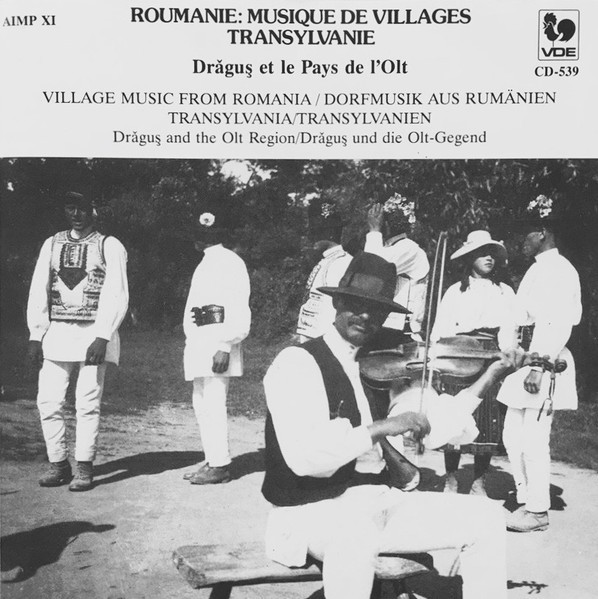
Starting from the recordings made by Constantin Brăiloiu between 1933 and 1943 and found on the album Musique de villages: Transylvanie, Drăguș et le Pays de l’Olt Region, I propose an interrogation into how we listen to works that belong to the intangible cultural heritage. I draw a connection between archival recordings and the phenomenology of listening, as formulated by the American theoretician Don Ihde in his seminal volume Listening and the Voice. The notion of witness is used to talk about the emotions and affects that might appear between a modern listener and voices of the musical folkloric past.

The concept of relational listening (Gardner 2023) contributes to the further understanding of this interaction and its symbolism. What are the character and the possible meanings of the virtual meeting between the identities of the one who is listened to and the one who is listening? I also discuss the absence of cultural heritage from the public sound space and the dynamics of this silence. In the end, I propose some techniques and practices of listening that might contribute to the accessibility of the meeting between a contemporary listener and recorded presences of the cultural heritage.
Listening both implies and creates closeness, notes the same researcher; we might even perceive this subtle, instantaneous closeness as invasive, generating internal disorder, a direct confrontation with an unknown territory.

The Listening Itself

V.A. - Musique de villages: Transylvanie, Drăguș et le Pays de l’Olt Region (1988)
“This morning I was listening to recordings made by Constantin Brăiloiu. A woman was singing a simple, repetitive melody. There was a moment when I felt that the woman was confessing to me – a distant, unforeseen listener – something that belonged to her intimacy, to her life. For a moment I was very close to a certain sensation of indecency. I felt how her slightly shrill voice was seeping into my skin. It was indecent to take part in this woman’s entire life out of the blue. These people had nowhere to hide, nowhere to go if they hurt someone or lost someone close to them.” (author’s trans.)

I wrote these things down on a social media platform in 2017, in the heat of the moment, with the sensation left by some of the songs on the album Musique de villages: Transylvanie, Drăguș et le Pays de l’Olt Region, recorded by Constantin Brăiloiu and his team between 1933 and 1943, still fresh in my mind. Now I would like to take the analysis of this form of listening further. How do we get closer to intangible heritage so as to bring sound archives out of their inactive state? Why is heritage so greatly removed from our day-to-day lives? Why do we not hear it? I argue that intangible heritage could become an active resource, a way of reconstructing our sense of belonging to a culture or of reflecting on the means of expression of our modern identities.

“Țăranul cântă pentru el însuși, nu pentru alții” [“The peasant sings for himself, not for others” (author’s trans.)] wrote Brăiloiu in 19291. Meaning that the peasant does not expect to be listened to by a foreign ear – the space of the song is a space of intimacy that manifests outwardly through the voice, but the voice never leaves this intimacy; it does not address an other in order to unburden itself. And yet, I had become, decades into the future, a witness to that song; the stranger trespassing into intimacy, who was discovering its story, listening uninvited to a voice that was not addressed to her.
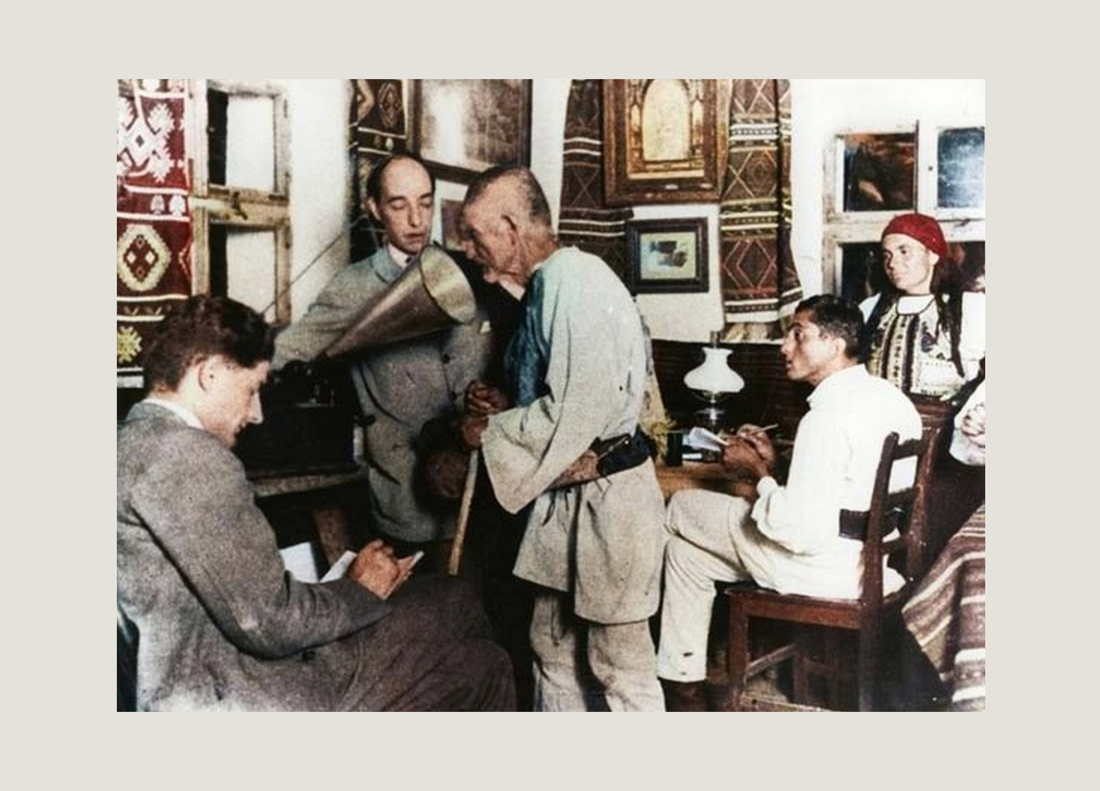
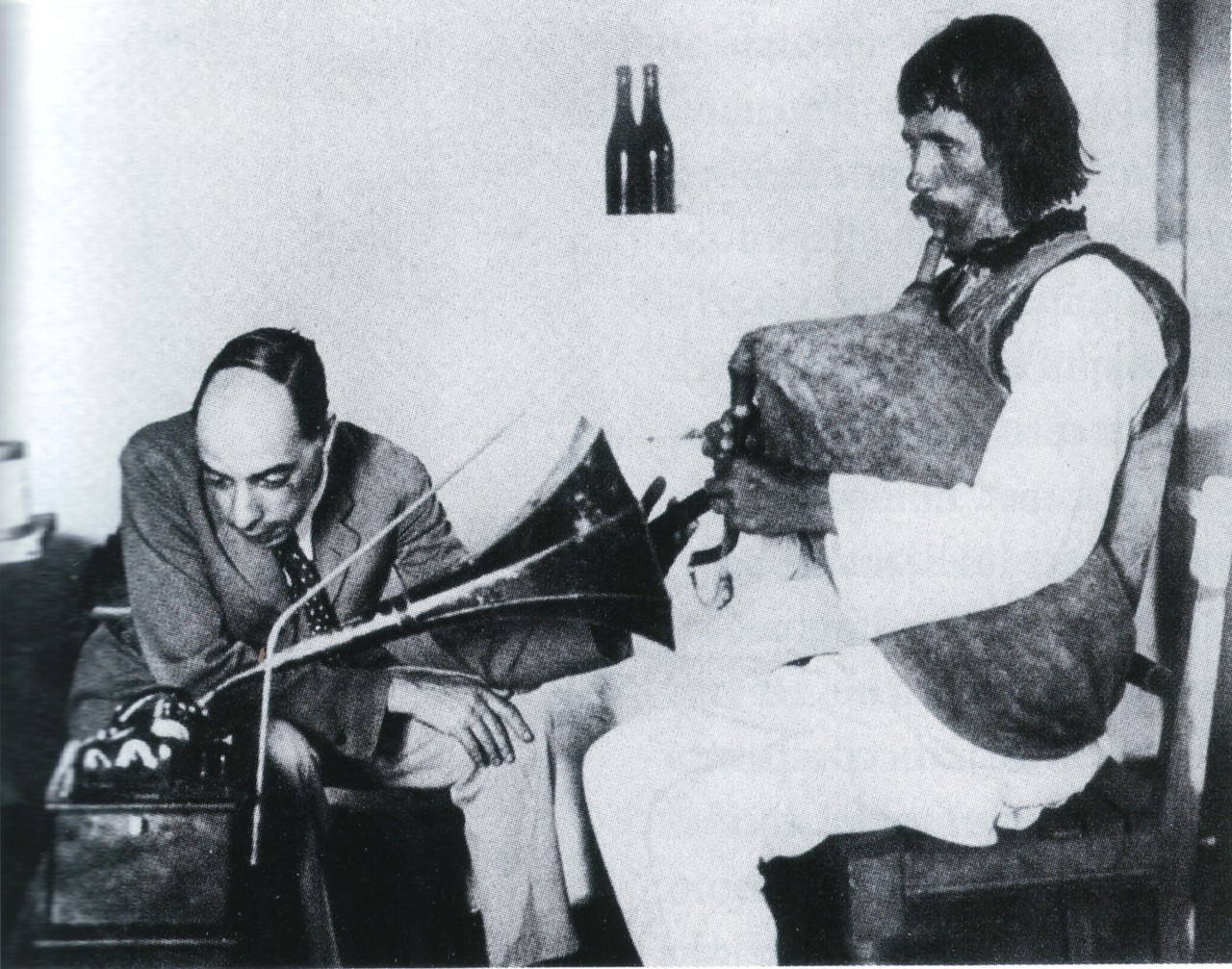
Constantin Brăiloiu recording folk musicians.

Spaces of Listening

“Where are we when we listen to music?” asks theoretician Marcel Cobussen2. Although this question was posed in the context of cultured, academic music, I believe it can be recontextualized for the current situation as well - that of encountering a recording meant to preserve a folk song. Where am I when I am listening to these recordings? Am I on my usual commute? Am I in the park? Am I in 2017, 1930 or 2025? Am I in the city or in a village? What spatial and affective relationship am I in with what I am hearing? “…while listening to music, one can never be completely in-the-world,” Cobussen also writes. Between two worlds that do not correspond, two worlds that are not in resonance, that do not resemble each other, what connection can exist between myself and this voice that I am hearing?

I am trying to define this sensitive, intermediate space that is reached through listening – this “not-in-the-world”. The headphones isolate me from the external world, but this isolation is not just physiological; the song itself isolates me from the space I am in, from my own time, from myself. My perception is dislocated. From my present, my corporeality, I become a ghostly presence in the present of the recording. The temporal relationship is radically altered. The encounter with the song provokes a rewriting of corporeality, of perceptual time. The involuntary participation in a confession triggers an affective, resonant process that places me in an inter-temporal, inter-corporal space, and this perceptual dislocation that seems to occur instantaneously, renders me vulnerable, challenges me to connect.

When conceptualizing the process of relational listening, Abigail Gardner writes about listening as a way of giving someone attention, and it is precisely this opening toward receiving the other, toward being next to the other, and being their witness, that affirms something about who we are, where and when we listen3. The possibility of creating a connection, of being present in the song, in the movement of an other’s voice, in sharing sadness, has become a reality to me through this song. Once this connection has been understood, I explore the space opened up by this deep listening.

It feels as though there is no way out of the song. We are together in a continuous present. “In listening humankind belongs within the event,” writes Don Ihde4. Technology and my own curiosity had transported me, across time, into an intimacy which would otherwise not have been accessible to me. I felt weighed down by what I was hearing, suddenly also responsible for having committed an intrusion, for having listened to something that was not meant for me. I now knew the woman who was singing, I knew her heart, the song had made me part of the sorrow she carried through her life. Her intimacy had become part of my intimacy. Once heard, the confession had created a direct relationship with me; with her voice I had entered a state of reciprocal confession.

I was participating in the event of the recording; I was an unknown, unseen, unheard presence, yet in the company of those who were immortalizing the song; in a different way from Brăiloiu and his team of ethnomusicologists, I also perceived myself as being present in the room turned meta-space, the recording place, but together with this woman, bearing witness to her, rather than to her song. More than listening to the song, I was listening to her.

I had become an “implicated witness” (Stephen 2019), a phrase used to describe a person's capacity to participate in suffering that is not their own, without trying to remove it, in a shared resistance in the face of pain. A similar process also captures the attention of British researcher Abigail Gardner, who speaks of relational listening, emphasizing the importance of the act of listening. When discussing the implications of the concept of listening, Gardner mentions the suffering we may feel through our involvement in the listening process. The leap into an other’s space means integrating a time different from one’s own and confronting discomfort (Gardner 2023).
Portrait of Constantin Brăiloiu. Photo courtesy of The Folklore Archive of the Romanian Academy Institute, Cluj-Napoca

Understanding the Listening

Listening both implies and creates closeness, notes the same researcher; we might even perceive this subtle, instantaneous closeness as invasive, generating internal disorder, a direct confrontation with an unknown territory. It is as if, in the moment of listening to a voice, to a song, to an unknown creation, we are frightened by the possibility of becoming aware of the alterity of the world beyond ourselves, trapped in an impossibility of recognizing it and ourselves in this encounter. In this situation, I was both the one invading the intimate space of the singer and the one feeling invaded by the presence of the song. In one of the most neutral moments of my daily life, I had in fact trespassed, through listening, upon the intimacy of an unknown woman. The song had taken me out of my usual rhythm, bringing me into an inner state of action, into a space where the potential for existential listening (Ihde 1976) could be fulfilled - a space that most often remains inaccessible, imperceptible and inconceivable.

This active state is one of the elements that differentiate listening from hearing, according to composer Pauline Oliveros. Listening is different from hearing. Listening is a psychological act (Roland Barthes), a fundamental human experience (Don Ihde), a way of expanding human consciousness (Pauline Oliveros), or a “fluid” space (Hildegard Westerkamp) we create between ourselves and the outside world. Listening implies involvement and intention. Spontaneously, I had found myself in an interaction with music of a different nature, one which was almost unknown to me. I was encountering the “disruptive nature of listening” described by Hildegard Westerkamp5, that capacity of sound to dis-locate and trans-mute attention toward a different dimension of reality, to unsettle. To my surprise, I was listening, not merely hearing.

By listening, I too was confessing something about myself. The relationship was personal, direct. That unknown woman, that anonymous voice that reflected none of the values I attached to music, had spontaneously taught me how to listen. Continuing Westerkamp’s ideas, I became aware that my choice, then as now, was to open myself up to what I was hearing, even if this meant experiencing a rupture in my daily life, in my knowledge, in my experience of what it means to listen.

This understanding of the notion of listening, although seemingly spontaneous, in fact incorporated a much more expansive trajectory – one which spoke about the education I had received, about positioning (being close to or far from an artistic act, from people, from music), about value criteria, about an entire intermedial rapport with the sound world, constructed over time and partially hidden until that moment. I understood I had not been present in the sound, because this presence speaks of a way of being equal to the other, the one who sings, and this equality does not pertain to the classical music culture I had internalized; a culture in which the territory is clearly divided between artists and audience, value and non-value. In listening, the distance between the woman in the song and myself was reduced to the point of nonexistence. I was by her side.
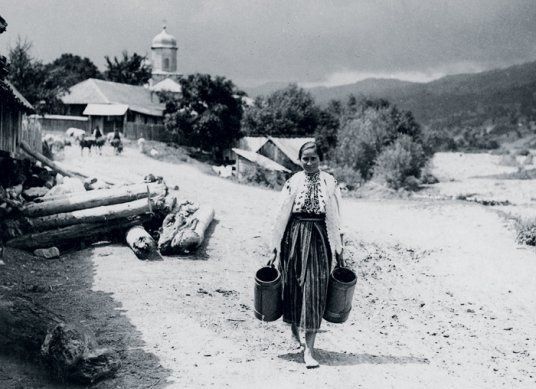
Photo by Iosif Berman

Who Is Heard? And Who Is Not?

“Muzica orașului este întotdeauna datorită unui compozitor al cărui nume îl știm și care ține foarte mult ca numele lui să fie știut”6. [“The music of the city is always thanks to a composer whose name we know and who insists that his name be known.” (author’s trans.)] This is what Brăiloiu describes as one of the essential differences between cultured music and folk music. Although anecdotal, this remark brings into focus the power relations, and the social construct that sustains the institution of the author. In Michel Foucault’s words: “In our culture and undoubtedly in others as well discourse was not originally a thing, a product, or a possession, but an action situated in a bipolar field of sacred and profane, lawful and unlawful, religious and blasphemous. It was a gesture charged with risks before it became a possession caught in a circuit of property values”7. I am only tangentially touching on this issue of authorship and the understanding of an author’s function in the social system of transmitting and perpetuating values within the sonic space. This discussion is relevant in the context of analyzing a mode of listening because Foucault emphasizes the property circuit which is, in itself, a circuit of power. At the same time, the relational listening that I am analyzing addresses a different relationality – that of the possibility of a horizontal rapport, in which the experience is co-authored by both entities – the one who sings and the one who listens.

Going back to Brăiloiu’s remark, it addresses a certain type of ego that seems to have inflated along with urban development; the only way to still be someone in an urban crowd, where direct neighborly relations have taken on a distorted meaning, is to become a celebrity, someone famous, someone whose “name is well known”. For me, Brăiloiu’s words also involve a difference in the relationality born with these two musical worlds, in the response of the one listening to either classical music or to a folk recording, never both.

It is no less valuable to listen to the music of a person whose name is not known. Listening does not open a power relation, but a horizontal one of mutual openness. But the fact that a simple recording can open such a perceptual channel in a daily life that does not invite such inter-human and sonic ways of relating can be disruptive, destabilizing. Reformulating Brăiloiu’s remark, I could say that, in the city, we only listen to the names that are already known to us and give up on any other aesthetic or inter-human ways of relating that might be challenging. Because of this, countless ways of listening, or even the polyphonic listening described by Don Ihde, remain unknown to us or simply disappear.

Brăiloiu also notes elsewhere that „la oraș, muzica o face unul și o ascultă altul. Ca să ajungă de la compozitor la public, trebuie să treacă printr-un tălmaci”8. [“in the city, one person makes music and another listens to it. For music to get from the composer to the audience, it needs to go through an interpreter.” (author’s trans.)]. Unlike classical music, where the person is sublimated by the performer, and the listener does not try to listen to the person, but to music in its purest form, this song brought me very close to the human being. The song was transporting me into the territory of the woman’s life. The person who would do the interpreting, the performer, was missing. Through listening, I was participating in a reality, not in an evocation of it.

Unexpectedly, I noticed myself traversing an inner path, a sound walk that had begun with the feeling of emotional dislocation, had continued with connection in listening and then had moved on to the analysis of the relationship thus created. The environment in which this soundwalk was taking place was my own internal landscape, successive layers of memory, experience, and relationality constructed with sound. The song was travelling through this internal world and I along with it. Just as in a soundwalk, the song was activating multiple inner spaces, attuning me to a different sensitivity, while I, myself, was becoming a resonant space.

I would have liked to hear the voice beyond the song, in the everyday life that was never recorded, nowhere preserved – that everyday life that, once listened to9, reveals an unexpected depth. Brăiloiu and his team had focused on the unique moment, the moment that sums up all the qualities needed for it to be curated, recorded, preserved. Everything else – the sounds of the village, the voices in the woman’s home, the animals in the yard, the sounds of the house, her way of speaking – had no significance for the recording team. My imagination was opening up this world as well, contextualizing the singing voice I was hearing into a sonic landscape.

The voice itself did not evoke anything spectacular, no emphasis – it was neither crafted nor processed; it did not wish to direct my attention to something in particular, nor to anything external. It was telling the story with no instrumentation, no heightened emotions. It was not trying to alter me. The voice did not wish for a particular kind of listener because, actually, I was not at all included in the purpose and the moment of the recording, in the song itself. I was the intruder. And it was precisely this lack of intentionality that was transformative, opening up the sensitive space of close, deep listening, as Oliveros puts it.
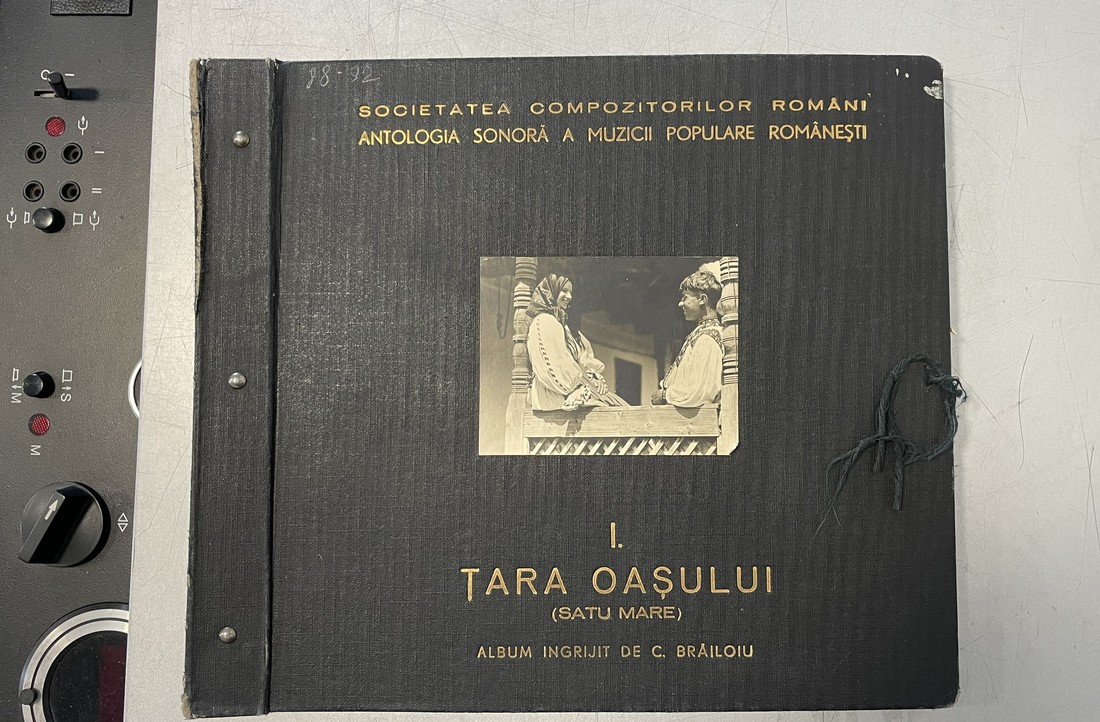
Photo courtesy of The Folklore Archive of the Romanian Academy Institute, Cluj-Napoca

Listening to Heritage. Archives as Sensitivities.

I use this example of my personal encounter with Constantin Brăiloiu’s recordings to speak about the necessity of understanding the plurality of ways in which we interact with the things we hear – about spontaneous distances and proximities, the sensitive spaces thus opened, the social and trans-generational ecologies that we are part of, the engagement or the lack of interest which we can experience and their causes; about the need for a sonic culture through which we can decode such encounters and integrate their multiple meanings into our lives.

Heritage recordings are, of course, a resource for researchers. But they can also serve as an educational resource, precisely because of the symbolic value of the encounters they involve: direct contact with a different historical context, with the expressions, rhythms, and spoken language of the time. By listening to such recordings we hear, we participate in a time different from our own, which in turn creates the conditions for a cognitive and emotional opening of a different nature than that of the usual educational process. In addition, connection through listening could contribute to the normalization of social relations, and an expanded understanding of the “other”, the unknown. I believe that early exposure to such recordings, becoming aware of and discussing the various reactions that might arise while listening, could reduce intergenerational distances through sensorial cultural knowledge and its integration into lived and learned daily life. I consider that it is the very exceptional nature of these types of encounters with the intangible heritage that can contribute to mending intergenerational ruptures, and to the more difficult acceptance of the sensitive and informational content they hold within.

Strangely enough, the general perception of these recordings is that they contain material that is not addressed to us. This text focuses precisely on the extensive potential of the direct, symbolic encounters that heritage recordings can facilitate. When integrated into the educational process as living materials, as the voices of people in whose lives we might recognize ourselves, they could open up necessary discussions on textuality, linguistic transformations, psychology, aesthetics, individual and collective authorship, anonymity and public recognition.

“Măicuțo când m-oi făcutu / O plouat și-a bătut vântu / De s-o legănat pământu / Păi cum o fost vremea de rea, măi / Așa e inima mea / Cum o fost de tulburată / Inima ca a mia stricată” [“Mother dearest, when you gave birth to me / It rained and the wind blew / Until the earth swayed / And just as the weather was so bad, well / So is my heart / And just as troubled as it was / So a heart as mine is broken.” (author’s trans.)]

The voice of the woman in the recording made by Brăiloiu opened a path for me to an expanded understanding of what it means to listen; the spontaneous engagement I can feel toward a story that, even if told in a way I might not be used to, has shown me the previously existing limits of my own listening processes.

Recordings bring us closer to a bygone world that they make audible. Through the witness role they grant us, they subtly act on our knowledge and senses. At the same time, I believe that heritage recordings can become, for each of us, tools for understanding and questioning feelings of belonging, nationality, and identity.


  1. Brăiloiu 1979, pp. 69-92. ↩︎
  2. Cobussen 2008, p. 139↩︎
  3. "I am using listening as a mode of giving attention to someone, or to something. I take this idea of “giving attention” to argue that this process is complicated by who, where, and when we listen." Gardner, p. VIII↩︎/li>
  4. Ihde 1976, p. 109↩︎
  5. Wsterkamp 2019, p.45-63↩︎
  6. Brăiloiu, p. 127↩︎
  7. Foucault 1977, p. 124↩︎
  8. Brăiloiu, p. 29↩︎
  9. There is a “depth” to things that is revealed secretly in all ordinary experience, but that often remains covered over in the ease with which we take something for granted., Ihde, Don, p. 110↩︎


    Further Reading:


  1. Brăiloiu, Constantin. Despre folclorul muzical în cercetarea monografică, in vol. Opere, IV, Editura Muzicală, Bucharest, 1979
  2. Brăiloiu, Constantin. Muzica populară românească, in Opere VI, Editura Muzicală
  3. Brăiloiu, Constantin. Puterea socială a muzicii, in Opere VI, Editura Muzicală
  4. Cobussen, Marcel. Thresholds: Rethinking Spirituality Through Music. Routledge, 2008
  5. Foucault, Michel. The Author Function in Language, Counter-Memory, Practice, p. 124,. Cornell University Press, 1977
  6. Gardner, Abigail. Listening, Belonging, and Memory. Bloomsburry, 2023
  7. Ihde, Don. Listening and the Voice. Phenomenologies of Sound, Ohio University Press, 1976
  8. Oliveros, Pauline. Deep Listening. A Composer’s Sound Practice. Deep Listening Publication, 2005
  9. Stephen, Frosch. Those Who Come After: Postmemory, Acknowledgement and Forgiveness. Palgrave Macmillan, 2019
  10. Wsterkamp, Hildegard. The Disruptive Nature of Listening: Today Yesterday Tomorrow, in Sound, Media, Ecology, 2019


*Translated from Romanian by Eliza Demian Pătrașcu (Artist & Researcher).

**This article is part of the project The Sonic Turn, co-financed by AFCN. The project does not necessarily represent the position of the Administration of the National Cultural Fund. AFCN is not responsible for the content of the project or the way its results may be used. These are entirely the responsibility of the funding beneficiary.
About the Author

Maria Balabaș

Romanian singer, musicologist and journalist, Maria Balabas runs her own radio show Dimineața crossover on Radio Romania Cultural, being one of Romania’s female voices who spreads diverse contemporary music all over the country. She is interested in new forms of radiophonic creation, as well as music composition and sound design.

Facebook page
Share this Article
Next Article
DECONSTRUCTIONS

The Music of the Other

In today’s globalist existence, the Other is everywhere, everyone is an Other for somebody; this is an attempt to deconstruct the way we, as a society, perceive the Stranger.

Cosmin Mirea
More Articles
FOCUS ON

Collecting My Heritage(s)

Building a music collection might have implications for the discovery and conservation of a music heritage.

Claudiu Oancea
FOCUS ON

The Shadow of a Leaf in Water

I rely on different modal harmonies from Western and Iranian music and embrace a hybrid of sonorities that can belong to either of the traditions.

Aida Shirazi
LOCKDOWN & ISOLATION

Solidarity in Times of Pandemic

This is the exact moment to start paying attention.

Rabih Beaini